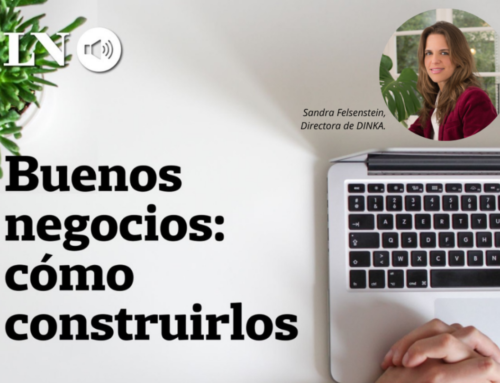
At the age of 26, engineer Sandra Felsenstein began to shape what would become a consultancy to help Argentine designers market their products abroad. Over time, it modified the core business and focused on providing tools for small and medium-sized businesses. This year it projects to bill $3.2 million.
Argentina was going through times of economic recovery, after the crisis that had hit society hard in 2001, and the twin surpluses had been established as a kind of flag that promised some time of prosperity. It was 2005 and Sandra Felsenstein, then 26 years old, found a business opportunity when thinking about how she could help local designers looking to market their products abroad. But he saw that there were even more possibilities to advance, especially in the products offered for SMEs. And so he founded, in 2006 and with an initial investment of US$
13,000 (own funds), Dinka, a consulting firm that provides management, professionalization, development and resource optimization services, which includes process reengineering, cost reduction, structure organization and commercial management. In 2017 it had a turnover of $2.5 million and expects to close this year with an annual turnover of $3.2 million.
Trained as an Industrial Engineer at the University of Buenos Aires, with a postgraduate degree in Strategic Marketing (University of Belgrano) and several business specialization courses, such as Think Diuerent (IAE Business School), Creative Lab (IAE), Foreign Trade (BankBoston Foundation), TPM and Lean (J&J), among others, Felsenstein began her professional career in an industrial plant of the Johnson & Johnson company. Later, he worked at a well-established financial firm, analyzing European and United States companies to build investment portfolios. Later, he joined a consulting firm, assigned to process reengineering for Quilmes and Techint. At that time, he was offered representation by Bicg, a Spanish consulting firm specialized in innovation and new ways of working for those who led the project to move Repsol YPF in Argentina to the new César Pelli towers in Puerto Madero.
All of these previous experiences in companies, although they were very important in her training, finally confirmed her suspicions that desks were not for her and that what motivated her most were the challenges, the constant changes, the non-monotony, she says.
"For this reason, one day I kicked the desk and looked for what would make me happy. The conventional company format was no longer attractive to me. I have traveled an interesting path to reach the consulting firm that we are today, discovering different types of companies with their differentiated needs. Seen from different angles, it is possible to design a service format that fits just the right size for each company," shares Felsenstein.
change processes
His path in multinational companies allowed him to notice that cultural change and the implementation of new management tools is usually very slow. “The challenge of
Working with small and medium-sized firms requires constant processes of change and that improvements are seen quickly and continuously. It also requires, in many cases, rethinking strategies, facing possible resistance to changes, generational clashes, reorganizing and optimizing existing resources. Precisely, those are the challenges that decided me to bet on this segment,” adds Felsenstein.
What were the first obstacles you had to face when starting out? “Afortunadamente, no hemos encontrado demasiadas”, sostiene con orgullo.
And he clarifies that, as happens in any business that begins its activity, the initial task is to attract the first customers, which requires an effort at the beginning.
“But it wasn't that difficult, since the proposal was attractive, we understood a real need in the market and we were offering what several SMEs were needing.”
How did he do it? "Of course, I began to promote myself among my closest environment and, also, to use the computer tools that we have at our disposal today. It was through the Internet that I managed to get my first client. It was very important for me, and I always remember it with great gratitude, since after a few weeks he recommended me to other people and thus began our spiral of growth."
The other very important point was to achieve the formation of a solid work team that was very committed to the project. “I needed to form an interdisciplinary stau, well focused and with perfectly defined talents and abilities.”
Looking ahead to the rest of the year, the entrepreneur hopes to continue growing organically and sustainably, both in terms of clients and also in terms of the internal team, which today is made up of six collaborators who accompany her in her daily tasks. “On the other hand, increase our participation in projects in the interior of the country and in other countries in the region,” he advances.
Dinka
Initially, the name of the company founded by industrial engineer Sandra Felsenstein, Dinka, arose from a play on words: “Designos Kontemporáneos Argentinos.” “It's from when the company, in its beginnings, was dedicated to representing Argentine designers and marketing their products abroad,” says the entrepreneur.
Currently, the firm offers its services to three large groups of companies:
Family businesses and large SMEs that need to restructure, reduce costs, be more efficient or reengineer processes.
Smaller SMEs seeking to professionalize, increase their profitability, rethink their structure, market positioning.
Start-ups, which are normally projects that rely on an idea but need help to do market research, provide added value to the project, find a business model, put together a business plan and launch it.
Founded: 2006
Turnover 2017: 2.5 million
Initial investment: US$13,000
Employees: 6
See more: https://www.cronista.com/pyme/negocios/Aprender-de-multinacionales-para-profesionalizar-las-pymes-20181010-0003.html