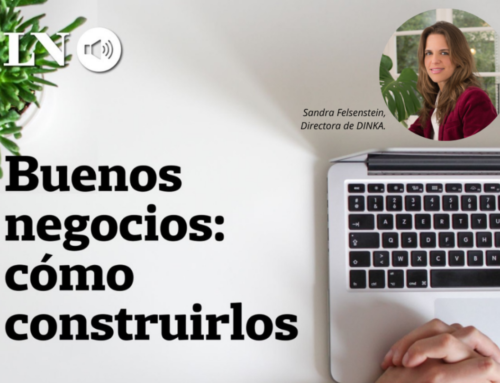
Engineer, 15 years ago she founded the consulting firm DINKA, where she leads an interdisciplinary team of 10 women. “We are empathetic, but we combine it with hard skills,” she defines herself. And it says that the smallest SMEs were the most affected by the pandemic.
Sandra Felsenstein is an Industrial Engineer and has a postgraduate degree in Strategic Marketing. He worked in industrial plants and in process reengineering. He also worked in a finance company, doing investment portfolio analysis for foreign companies. In 2005, at the age of 29, she decided to set up her own consulting firm, DINKA, aimed at SMEs and made up of an interdisciplinary team of 10 female professionals.
He says that his client portfolio includes some large company names, but that 90% are SMEs and entrepreneurs. "They are people who are very used to getting ahead and fighting it; the Argentine businessman is not usually in favorable contexts nor does he have policies that usually accompany him. In this sense we have a great challenge, but the good thing is that the businessman precisely because of these shortcomings developed the capacity for creativity and innovation to get ahead" describes Felsenstein, who was also a speaker at events organized by the Argentine chapter of Voces Vitales, the NGO founded by Hilary Clinton with the aim of identifying and training women to leadership positions.
What did the pandemic reveal for SMEs?
The pandemic accelerated a process that was going to take perhaps 5 years. Companies that are more familiar with innovation or those that had already been working on their digital transformation suffered much less from the effects of the pandemic. The pandemic revealed where we are going and destroyed archaic preconceptions such as task control or pre-specialty. What we always teach at the consulting firm was evident, which is that financial problems are not solved with money but with innovation.
What other consequences were there?
The pandemic also accelerated the need for efficiency in terms of processes and in using technological tools that help make better use of time or work better remotely.
Could everyone use those tools?
The smallest SMEs, with less back, are the ones that, along with the productive ones (which require in-person work), were most affected. The largest ones were able to navigate the situation better and those that belong to the most technological sector or linked to essential activities grew. Many of the most traditional companies went bankrupt and therefore the market share of others increased and they gained revenue. But it was because they fell by the wayside.
How do you rate women in consulting?
Consulting is more of a man's world. I think that earning the right to a flat is more difficult as women. Everything costs twice as much because society's preconceptions must be broken down. I think it's harder for women to sell ourselves. Even the least educated man dares to go to market before one. I felt the challenge of being a woman in areas appropriated by men, both in the consulting firm and in the engineering career. Now, after so many years of work, we have a portfolio of clients that supports us, but at first I felt that my word was underestimated because I was a woman. Being a woman is a barrier to entry.
For example?
I was asked how I thought I could manage a team of salespeople as a woman. The abilities are not given to you by gender but by training and experience in the field. Before starting the consulting firm, I managed teams of men in the plant, and I was the only woman. I have a list of tremendous anecdotes from the Faculty, which even involved having to think about how to dress. When I started the consulting firm I was already seasoned and I think that also served as my letter of introduction. I am very persistent and never doubted the added value of our proposal. Today I have a lot of confidence not only in my abilities, but also in those of the entire team.
Are there a lack of women in the hard sciences?
It is true that there is a lack of women studying hard careers, they generally choose softer careers and I think this responds to how men and women are socially pigeonholed, when in childhood we are raised giving dolls to girls and building blocks to boys. However, I believe that there are skills that come more naturally to women than to men, such as empathy. But that in no way implies lacking the ability to work with harder skills. In consulting, empathy is a fundamental tool, but it is combined with other hard skills, such as control boards, processes, indicators. That combination is our true added value.
There is also a lack of women in leadership positions
The rate of women in leadership positions in SMEs, which are the ones that drive the market, is very low. I think there is something we are not realizing. I believe that if we could encourage more and more women to reach leadership positions, or enter tougher careers, it would be a benefit for everyone. Men are more risky and it is something that women have to learn.
Because?
We are such perfectionists that in this search for perfection we are losing ground, just due to lack of confidence. A man who presents a project talks about it as a mega business and the woman as something smaller, although both are the same. Another reality is that household chores are not equitable and women end up occupying several roles simultaneously, making professional development more difficult; It is more complicated if the responsibility of caring for the children and the home falls on us alone. For all this, there are more female entrepreneurs than SME owners; It's harder for us to make that leap. Contrary to what was expected and desired, the pandemic, in terms of the division of tasks, caused the gap between men and women to grow. Although some men began to do some household chores that they did not do before, everything continues to fall more on women.
What immediate benefits would there be with more women in leadership positions?
First, because of their capacity for empathy, a fundamental tool for having a motivated team. Women, in general, are more organized and detail-oriented; two benefits when it comes to leading. And there is, of course, the training. I am not in favor of hiring a woman if she does not have training in line with the needs of the position, but it is also true that women, being perfectionists, tend to be more educated and train themselves in everything they consider necessary to continue growing.
–
Por Laura Andahazi Kasnya.