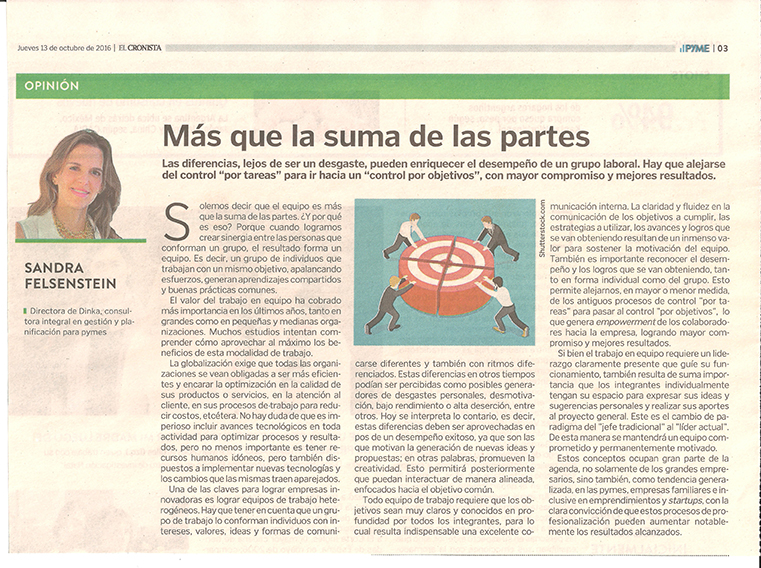
We often say that the team is more than the sum of its parts. And why is that? Because when we manage to create synergy between the people who make up a group, the result forms a team. That is, a group of individuals who work with the same objective, leveraging efforts, generate shared learning and common good practices.
The value of teamwork has become more important in recent years, both in large and small and medium-sized organizations. Many studies try to understand how to make the most of the benefits of this type of work.
Globalization requires that all organizations are forced to be more efficient and address optimization in the quality of their products or services, in customer service, in their work processes to reduce costs, etc. There is no doubt that it is imperative to include technological advances in all activities to optimize processes and results, but no less important is having suitable human resources, but also willing to implement new technologies and the changes that they entail.
One of the keys to achieving innovative companies is to achieve heterogeneous work teams. It must be taken into account that a work group is made up of individuals with different interests, values, ideas and ways of communicating and also with different rhythms. These differences in other times could be perceived as possible generators of personal exhaustion, demotivation, low performance or high dropout, among others. Today the opposite is interpreted, that is, these differences must be taken advantage of in pursuit of successful performance, since they are what motivate the generation of new ideas and proposals; In other words, they promote creativity. This will later allow them to interact in an aligned manner, focused on the common objective.
Every work team requires that the objectives be very clear and known in depth by all members, for which excellent internal communication is essential. The clarity and fluidity in the communication of the objectives to be met, the strategies to be used, the progress and achievements that are obtained are of immense value in sustaining the team's motivation. It is also important to recognize the performance and achievements that are obtained, both individually and as a group. This allows us to move away, to a greater or lesser extent, from the old control processes “by tasks” to move to control “by objectives”, which generates empowerment of collaborators towards the company, achieving greater commitment and better results.
While teamwork requires clearly present leadership that guides its operation, it is also very important that members individually have their space to express their personal ideas and suggestions and make their contributions to the general project. This is the paradigm shift of the "traditional boss" to the "current leader." In this way a committed and permanently motivated team will be maintained.
These concepts occupy a large part of the agenda, not only of large businessmen, but also, as a general trend, in SMEs, family businesses and even in ventures and startups, with the clear conviction that these professionalization processes can significantly increase the results achieved.