If the consumer is the most important thing, how to reach them cannot be a stroke of luck left to chance. Defining it and thinking about where to find it is the starting and finishing point of every business. What the specialists say. Some experiences that gave good results.
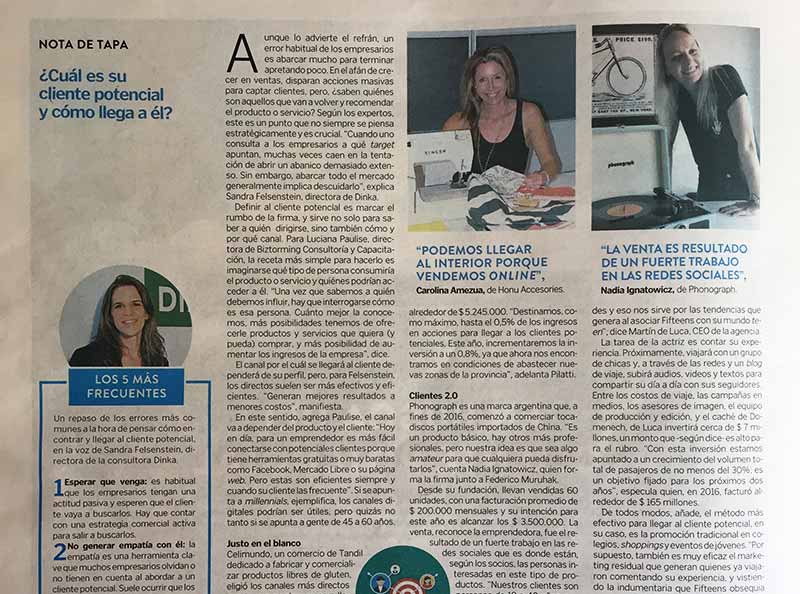
Although the saying goes, a common mistake of businessmen is to cover too much and end up pressing too little. In the desire to grow sales, they launch massive actions to attract customers, but do they know who are those who are going to return and recommend the product or service? According to experts, this is a point that is not always thought out strategically and is crucial. "When you ask what target they are targeting, they often fall into the temptation of opening too wide a range. However, covering the entire market generally means neglecting it," explains Sandra Felsenstein, director of DINKA.
Defining the potential client is setting the direction of the firm, and serves not only to know who to address, but also how and by what channel. For Luciana Paulise, director of Biztorming Consulting and Training, the simplest recipe to do this is to imagine what type of person would consume the product or service and who could access it. "Once we know who we need to influence, we have to ask ourselves what that person is like. The better we know them, the more likely we are to offer them products and services that they want (and can) buy, and the more likely we are to increase the company's revenue," he says.
The channel through which the customer will be reached will depend on their profile, but, for Felsenstein, direct channels are usually more effective and efficient. “They generate better results at lower costs,” he says. (continues)
– Column – Who is your potential customer and how to reach them?
The 5 most frequent
A review of the most common mistakes when thinking about how to find and reach potential clients in the voice of Sandra Felsenstein, director of the DINKA consulting firm.
1- Wait for him to come: it is common for businessmen to have a passive attitude and wait for the client to come looking for them. You have to have an active commercial strategy to go out and look for them.
2- Not generating empathy with him: Empathy is a key tool that many entrepreneurs forget or do not take into account when approaching a potential client. It often happens that business owners communicate what is important to them without really understanding where “the customer's shoe is tight.” Demonstrating that you really understand the potential client's problems is key.
3- Purely technical descriptions: many entrepreneurs fall into the temptation of describing the product or service offered from a technical point of view, without highlighting the benefits and added value of what they want to offer.
4- Not adapting communication according to the interlocutor: if you have different customer segments, it is essential to adapt communication in each case. Over-information can also become counterproductive and confusing.
5- Not having a sales team: many times entrepreneurs lack sales teams or are poorly motivated. It is essential to have solid teams, with established objectives that allow the business to leverage.