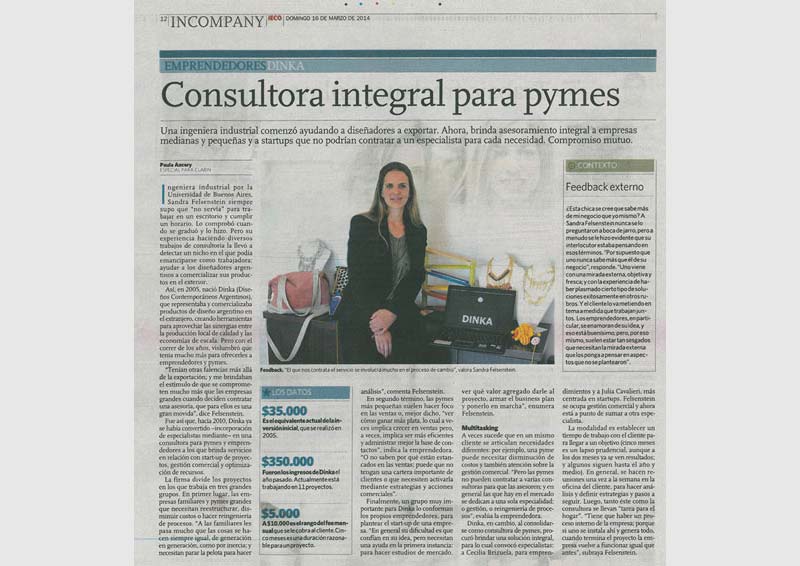
An industrial engineer began helping designers to export. Now, it provides comprehensive advice to medium and small companies and startups that could not hire a specialist for each need. Mutual commitment.
iEco supplement – 16 March 2014
An industrial engineer from the University of Buenos Aires, Sandra Felsenstein always knew that she was “no good” at working at a desk and keeping a schedule. He proved it when he graduated and he did it. But her experience doing various consulting jobs led her to detect a niche in which she could emancipate herself as a worker: helping Argentine designers market their products abroad.
Thus, in 2005, Dinka (Argentine Contemporary Designs) was born, which represented and marketed Argentine design products abroad, creating tools to take advantage of the synergies between quality local production and economies of scale. But as the years went by, he realized that he had much more to offer entrepreneurs and SMEs.
“They had other shortcomings beyond exporting; and they gave me the encouragement that they commit much more than large companies when they decide to hire consulting, which for them is a great move,” says Felsenstein.
Thus, by 2010, Dinka had already become – incorporating specialists through – a consulting firm for SMEs and entrepreneurs to whom it provides services in relation to project start-ups, commercial management and resource optimization.
The firm divides the projects it works on into three large groups. Firstly, family businesses and large SMEs that need to restructure, reduce costs or reengineer processes. “It often happens to family members that things are always done the same, from generation to generation, as if by inertia; and they need to stop the ball to do analysis,” says Felsenstein.
Secondly, smaller SMEs usually focus on sales or, rather, “seeing how to earn more money, which sometimes means growing sales but, sometimes, means being more efficient and better managing the contact base,” says the entrepreneur. "Or they don't know why they are stagnant in sales; they may not have a significant customer base or they need to activate it through commercial strategies and actions."
Finally, a very important group for Dinka is made up of the entrepreneurs themselves, to propose the start-up of a company. “In general, their difficulty is that they trust their idea, but they need help in the first instance: to do market studies, see what added value to give to the project, put together the business plan and put it into motion,” Felsenstein lists.
Sometimes it happens that different needs are articulated in the same client: for example, an SME may need cost reduction and also attention to commercial management. "But SMEs cannot hire several consulting firms to advise them; and in general, those on the market are dedicated to a single specialty: either management, or process reengineering," evaluates the entrepreneur.
Dinka, on the other hand, when consolidating itself as an SME consultant, sought to provide a comprehensive solution, for which it brought in specialists: Cecilia Brizuela, for entrepreneurship, and Juliana Cavalieri, more focused on startups. Felsenstein is in charge of commercial management and is now about to add another specialist.
The modality is to establish a working time with the client to reach an objective (five months is a reasonable period, although after two months results are already seen; and some continue up to a year and a half). In general, meetings are held once a week at the client's office to analyze and define strategies and steps to follow. Then, both he and the consultant take “homework.” “There has to be an internal process of the company; because if you settle there and generate everything, when the project ends the company returns to functioning the same as before,” emphasizes Felsenstein.
Feedback externo
Does this girl think she knows more about my business than I do? Sandra Felsenstein was never asked outright, but it often became clear to her that her interlocutor was thinking in those terms. “Of course you never know more about his business than he does,” he replies. "One comes with an external, objective and fresh perspective; and with the experience of having successfully implemented certain types of solutions in other areas. And the client brings it into the subject as they work together. Entrepreneurs, in particular, fall in love with their idea, and that is great; but, for that reason, they tend to be so biased that they need an external perspective to make them think about aspects that were not considered."
News links:
https://www.ieco.clarin.com/economia/Consultora-integral-pymes_0_1102690088.html
https://www.ieco.clarin.com/economia/Feedback-externo_0_1102690086.html